

Why Do Bingo Sites Share the Same Games?
Ever opened two bingo websites and found familiar rooms, game formats or jackpot names? The explanation may be shared software, a networked bingo room or a common operator. We look at how these arrangements work, what players actually share and why identical games are not proof that two bingo brands are sister sites.
On This Page show hide
What Shared Bingo Games Can Tell You
Why Do the Same Bingo Games Appear on Different Sites?
Open two online bingo sites and you might find much the same selection: 90-ball rooms, 75-ball games, familiar ticket prices, similar countdown timers and even matching room names.
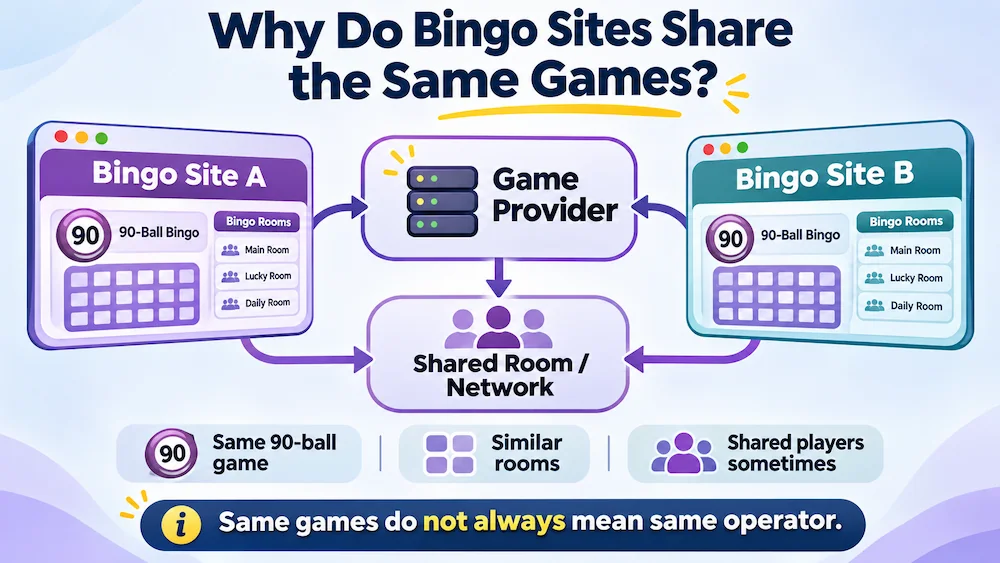
There are several possible explanations. Both websites may buy games from the same software company. They may connect to a shared bingo network. Or they may be brands operated by the same licensed gambling business.
These arrangements can overlap, but they describe different parts of the online bingo industry.
A website's branding is only the part players see first. Behind the lobby sits software that handles ticket purchases, number draws, game results and prize allocation. A supplier may make that technology available to more than one gambling operator.
This makes repeated games relatively unsurprising. What is more interesting is whether two sites simply offer the same type of game or actually connect players to the same room.
Does the Same Bingo Room Mean the Same Players?
Sometimes it does.
A networked bingo room can be accessed through several different websites. Players may enter from different brands but participate in a common game hosted through the network.
Consider an illustrative example.
Bingo Site A and Bingo Site B both offer a room called Friday 90-Ball. If they connect to the same networked session, players from the two sites could be participating in the same draw.
If the websites independently host two games using the same format and room name, the players would not necessarily be together.
That distinction matters when comparing online bingo sites. A matching game title is not enough to establish shared player liquidity.
Useful evidence would include the provider's published network arrangement or reliable information showing that the rooms are connected. Room schedules and player counts may provide clues, but should not be treated as proof.
Who Actually Supplies Online Bingo Games?
A gambling operator does not need to develop every bingo game and piece of software itself.
Specialist businesses can supply bingo technology, host games and provide network services used by other licensed operators.
The UK Gambling Commission recognises this distinction in its licensing framework.
A remote bingo operating licence covers businesses providing bingo facilities to their own customers. Separately, the Commission has a remote bingo game host licence category for qualifying software businesses hosting bingo facilities that customers access through other operators.
The Commission also regulates gambling software supply. These are separate responsibilities, even when a provider supplies multiple brands.
For example, two websites could use the same bingo supplier without being owned by the supplier or by each other.
There is another difference worth recognising:
- Shared game software: two sites use the same supplier's game technology, potentially in separate sessions.
- Shared bingo network: multiple sites access connected rooms or games, potentially bringing players into the same sessions.
- Same legal operator: the same licensed gambling business provides the relevant customer-facing services.
The commercial agreements and technical arrangements determine which of these descriptions applies.
Real Example: Playtech and SkillOnNet
One documented example shows how the supplier relationship works in practice.
In November 2025, Playtech announced an expanded agreement with SkillOnNet to become its exclusive bingo provider in the UK and Mexico.
The announcement identified PlayOjo and PlayUZU among the brands covered by the partnership. It also described the launch of Zingo Bingo, which joined the Playtech Bingo network.
According to Playtech, the arrangement gave SkillOnNet access to shared liquidity across networked rooms.
Shared liquidity is an important detail. It means network participation is about more than supplying similar-looking software to several sites. It can also involve games available through a connected pool of players.
This is a documented supplier-network example, not evidence that every Playtech-powered bingo website has identical rooms or shares the same customers.
The announcement establishes the partnership and network arrangement at that time. The exact live room selection should still be checked separately for each brand.
Source: Playtech and SkillOnNet Expand Partnership with Exclusive Bingo Deal .
A Second Example: Broadway Gaming and Dragonfish
A different kind of relationship appears in A2Z's Broadway Gaming research.
Broadway Gaming operates through more than one UK-regulated legal entity and acquired the Dragonfish B2B and platform business in 2022.
A2Z's operator research separates Broadway Gaming Limited, Broadway Gaming Ireland DF Limited and the Dragonfish technology relationship.
That separation prevents a common classification error. A brand associated with the wider Broadway business or Dragonfish technology should not automatically be assigned to the wrong legal operator.
For the operator-level details, see the A2Z Broadway Gaming Group research .
Are Bingo Sites With the Same Games Sister Sites?
The game catalogue alone cannot settle that question.
Imagine two independently licensed bingo businesses buying room software from the same supplier. Both websites could display similar games without sharing a legal operator or corporate parent.
The opposite arrangement is also possible. A group may run several bingo brands, with those brands using different game configurations or suppliers.
To establish an operator-level relationship, check the company named in each website's licensing statement and compare their UKGC account numbers and declared domains.
A broader group connection may require additional ownership evidence.
For an explanation of these structures, see White Label vs Operator Groups Explained .
What Can Still Differ Between Bingo Sites?
Even where two brands connect to the same network, their complete player experiences can differ.
The bingo room itself may be shared while other features remain brand-specific.
These may include:
- welcome bonus eligibility and promotional terms
- registration and account arrangements
- available payment methods
- withdrawal information and limits
- additional games outside the shared bingo rooms
- customer-support channels
- navigation, accessibility and mobile experience
Even the same bingo format can feel different if one website offers more suitable schedules, clearer room information or a simpler mobile interface.
For players comparing sites, room availability, ticket prices, prize structures and the applicable terms are more useful than treating a matching game title as a complete comparison.
How to Compare Two Bingo Sites Properly
If two bingo websites appear to offer exactly the same games, start by comparing the actual room information.
- Look at the game format. Are both websites offering the same common bingo format, or a specifically named game?
- Compare room schedules. Matching schedules may be useful clues, but do not establish shared network participation.
- Identify the software provider. Look for provider information or published partnerships rather than guessing from the design.
- Check whether the room is networked. Reliable provider documentation is stronger evidence than matching colours or room names.
- Verify the legal operator separately. Compare the licensing statements and UKGC records of both websites.
- Compare the actual player conditions. Ticket prices, prizes, promotions and room availability can differ between brands.
The final result may identify the two brands as same-operator sites, members of a shared bingo network, or unrelated businesses using common software. A useful comparison records which relationship has actually been established.
Same Game Supplier
Two brands use bingo software from the same provider. Their rooms and player pools may still be separate.
Shared Bingo Network
Different websites access connected bingo rooms. Where the network is configured for shared liquidity, players may join the same games.
Same Legal Operator
Two bingo brands are provided by the same licensed gambling company. This relationship should be checked through operator and UKGC records.
FAQs
Why do different bingo sites have the same games?
Different bingo sites may use the same game supplier or participate in a shared bingo network. Some brands may also be operated by the same licensed gambling business.
Can players from different bingo sites play in the same room?
Yes, where the sites connect to a networked room with shared player liquidity. Offering the same game format does not necessarily mean the players share a room.
Does the same bingo software mean the same owner?
No. A software supplier can provide games to multiple unrelated gambling operators. Ownership and legal operation require separate evidence.
What is shared liquidity in online bingo?
Shared liquidity allows eligible players from participating websites to enter connected bingo games through a common network arrangement.
Can two bingo sites offer the same games but different bonuses?
Yes. The underlying game software may be shared while welcome offers, eligibility conditions, payment options and other customer-facing arrangements differ between brands.
Last checked: 13 November 2026
This guide explains bingo software, hosted game arrangements and networked rooms. Supplier relationships and live game availability may change over time.
- UKGC — Remote bingo operating licence
- UKGC — Remote bingo game host operating licence
- UKGC — Gambling software licence condition
- Playtech — SkillOnNet bingo partnership, November 2025
- Playtech — Shared Live Bingo Network, September 2026
- A2Z — Broadway Gaming Group research
A2Z distinguishes the legal operator, software supplier, shared network and consumer-facing bingo brand. Examples attributed to supplier announcements reflect the arrangements disclosed at the time of publication.