

Why Casinos Ask for Source of Funds — and What They’re Actually Checking
A Source of Funds request is not just a demand for “proof you can afford to gamble”. Operators use financial information to understand where gambling money came from, whether activity fits what they know about the customer and whether there are signs of third-party funding, fraud or money laundering risk.
Three Things to Know
Why Would a Casino Ask for Source of Funds?
A Source of Funds request normally appears because the operator wants to understand the origin of money moving through the account.
That can happen during routine ongoing monitoring or because something about the customer's activity has changed.
UK casino operators are expected to monitor transactions throughout the customer relationship and, where necessary, examine Source of Funds to check that activity is consistent with what they know about the customer and the customer's risk profile.
That does not mean every player should expect the same check at the same spending level. The approach is risk-sensitive.
A regular customer whose activity suddenly changes, for example, may attract more attention than a customer whose behaviour remains consistent with the information already held.
What Are They Actually Checking?
The operator is not simply looking for a large enough bank balance.
The more important question is whether the movement of money makes sense.
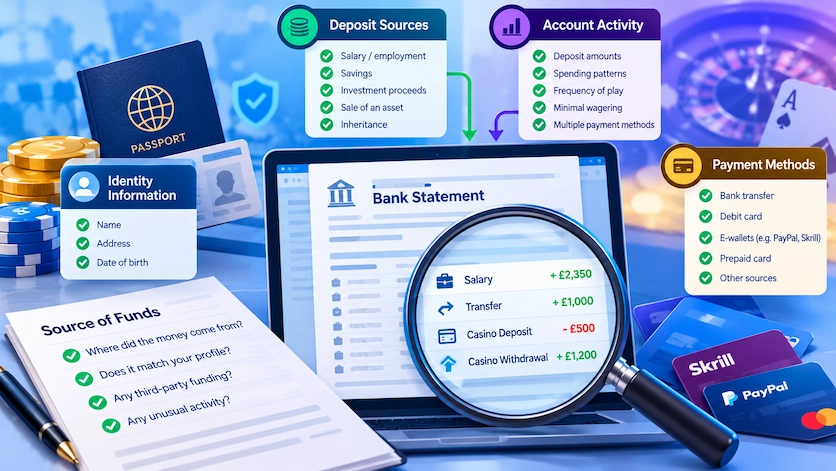
That can involve comparing:
- where deposits came from
- how much is being deposited
- known or declared income
- changes in spending behaviour
- whether third parties appear to be funding the account
- which payment methods are being used
- whether money is being deposited and withdrawn with very little gambling activity
A single item does not automatically prove wrongdoing. The operator is looking at the pattern as a whole.
What Can a Bank Statement Show?
Bank statements are useful because they can show both the origin of funds and how money moves before reaching a gambling account.
For example, an operator may be able to see salary payments followed by ordinary personal spending and gambling deposits. That is very different from unexplained large transfers arriving from several other people immediately before casino deposits.
UKGC consumer guidance specifically says gambling businesses may use bank statements to check whether Source of Funds appears legitimate.
The same guidance also mentions income patterns. A customer might, for example, have irregular income because of a house sale or another genuine one-off event.
That is why a financial pattern sometimes needs explanation rather than simply being labelled suspicious.
What Can Trigger a Closer Review?
The Gambling Commission's 2026 remote-casino risk assessment gives a much clearer picture than generic wording such as “high spend”.
Examples highlighted by the Commission include:
- gambling activity that appears disproportionate to declared employment
- money supplied by third parties
- several customers apparently sharing the same source of funds
- large deposits followed by limited wagering
- withdrawals being requested to different bank accounts
- multiple or unusual payment methods
- activity connected to higher-risk jurisdictions
One 2026 case example described an 18-year-old customer whose gambling activity appeared inconsistent with their employment and whose Source of Funds review showed third-party funding and use of multiple operators.
Another involved prepaid funds followed by minimal gambling and withdrawals to different bank accounts.
Those examples explain why Source of Funds is not simply another name for an affordability check.
What Evidence Might Be Requested?
The right evidence depends on the explanation being tested.
Someone saying the money comes from salary might reasonably be asked for a payslip or bank statement showing salary credits.
If the funds came from selling a property, evidence of the sale could be more useful.
Other possible evidence can include:
- recent bank statements
- payslips
- P60 or employment evidence
- investment statements
- evidence of savings
- documents showing a property or asset sale
- inheritance documentation where relevant
The aim should be to support the explanation given for the money, not to collect documents for their own sake.
For the distinction between this and Source of Wealth, see Casino KYC vs Source of Funds vs Source of Wealth .
What If They Ask When You Withdraw?
A Source of Funds request appearing during withdrawal is not automatically improper.
Something may genuinely have changed or a new risk may have emerged.
But timing matters.
UKGC rules say a withdrawal request should not trigger an information demand where the operator could reasonably have asked for that information earlier.
That is especially important where an operator has already allowed repeated deposits or substantial gambling activity before raising a question that was visible much earlier.
If the request appears only when you try to withdraw, the useful questions are:
- What exactly has triggered the review?
- What evidence is required?
- Why is that evidence needed now?
- Could the issue reasonably have been identified earlier?
For the withdrawal-specific rules, see Casino Withdrawal Pending: What Does It Actually Mean? .
What Recent UKGC Cases Show
The 2026 UKGC risk assessment is useful because the examples are much more specific than the idea that casinos simply “check affordability”.
The recurring concern is often the relationship between the customer, the money and the gambling activity.
If funds arrive from unrelated third parties, activity is far higher than the customer profile suggests, or money moves through the casino with very little actual gambling, the operator may need to investigate where those funds came from.
That is the central purpose of Source of Funds checking.
It is a financial-crime control first. It can overlap with broader customer-risk or safer-gambling work, but the concepts should not be merged into one generic “financial check”.
Third-Party Funding
Money entering the gambling account appears to come from relatives, friends or other third parties rather than the customer.
Income Does Not Fit
Gambling levels appear difficult to reconcile with the employment or financial profile already known to the operator.
Minimal Play
Significant funds are deposited, little gambling takes place and withdrawals are then requested, potentially to different accounts.
FAQs
Why has my casino asked for Source of Funds?
The operator may need to understand where gambling money came from because of ongoing AML monitoring, a change in account behaviour or another risk identified during the customer relationship.
Why does a casino want my bank statement?
A bank statement can help show where money came from, income patterns, third-party transfers and how funds moved before being deposited with the casino.
Is Source of Funds the same as an affordability check?
No. Source of Funds is primarily an anti-money-laundering control concerned with the origin of money. Financial information may also be relevant to safer-gambling or financial-risk assessments, but those are not the same purpose.
Can a casino ask where my savings came from?
Yes, where understanding the origin of those funds is necessary and proportionate to the customer's risk profile. The evidence requested should relate to the explanation being checked.
Can a casino ask for Source of Funds before paying a withdrawal?
Sometimes a new legal or regulatory issue can justify further checks, but UKGC rules say withdrawal should not trigger information requests that could reasonably have been made earlier.
Last checked: 30 October 2026
- UK Gambling Commission — Why gambling businesses want to know about your finances
- UK Gambling Commission — Ongoing monitoring
- UK Gambling Commission — 2026 remote casino AML risk assessment
- UK Gambling Commission — Customer identity verification
Source of Funds enquiries should be understood in the context of ongoing anti-money-laundering monitoring and the customer's risk profile. The evidence needed can vary according to what activity or source of money the operator is trying to understand.